
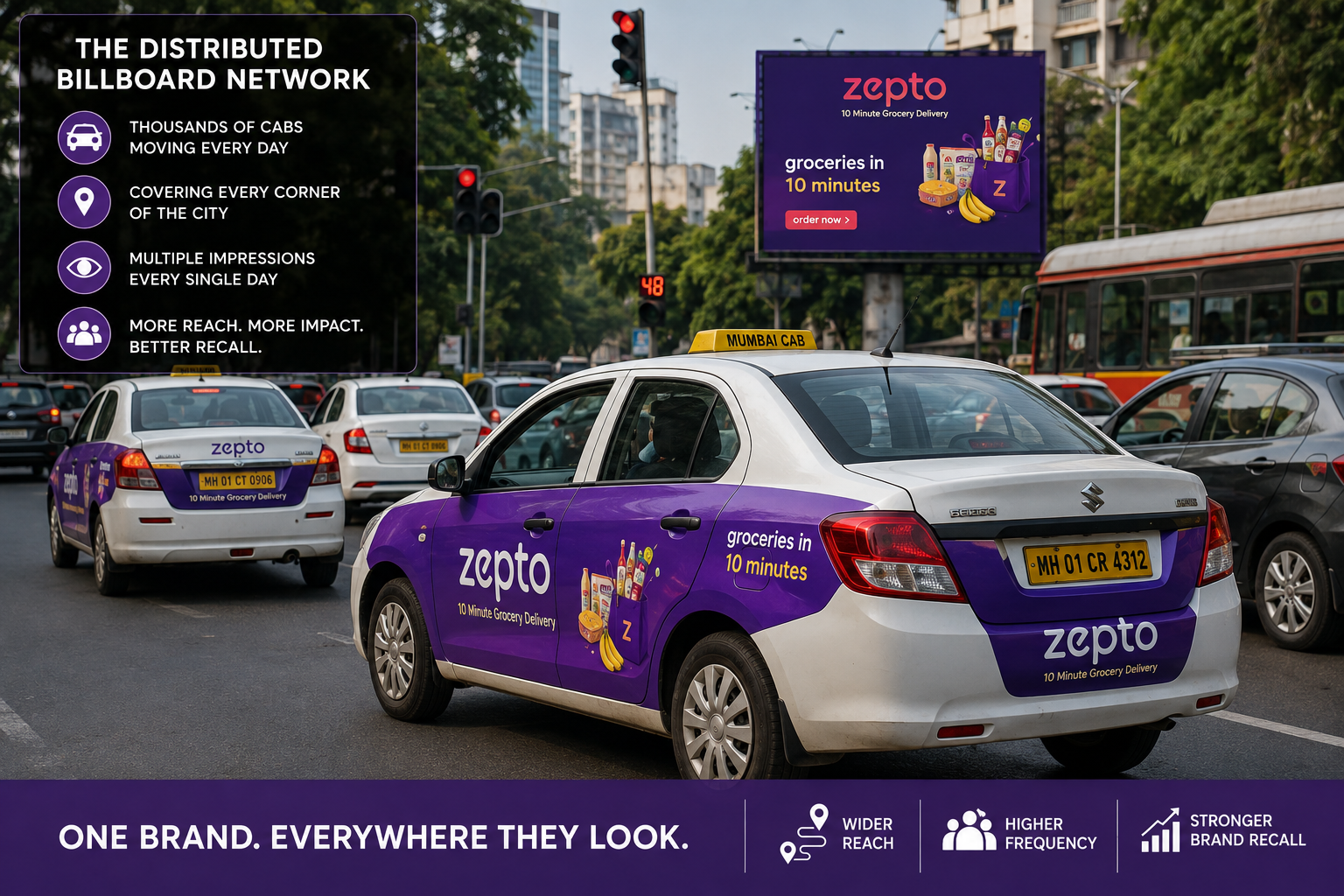
Turning Traffic Into an Attention Opportunity
Traffic is usually considered a frustrating part of the daily commute. For advertisers, however, those same pauses can create valuable opportunities for visibility.
At traffic signals, busy intersections, road bottlenecks, and slow-moving stretches, commuters naturally have more time to observe the environment around them. A branded cab positioned within this visual field can become an unexpected advertising touchpoint.
This creates the Traffic Pause Advantage—using moments of reduced movement to capture attention through mobile OOH advertising.
Why Cab Branding Works During Traffic Pauses
Traditional advertising often competes with multiple distractions. Consumers may scroll past digital ads or move quickly past static outdoor media.
Cab branding operates differently.
A branded vehicle is part of the traffic environment itself. When a consumer encounters a branded cab at a signal or during congestion, the advertisement appears naturally within their journey rather than interrupting it.

The combination of mobility, proximity, and waiting time can make cab branding particularly effective in dense urban environments.
The Value of Waiting Moments
A few seconds at a traffic signal may seem insignificant. But when consumers encounter the same branded vehicle across multiple journeys, these small moments can accumulate.
A consumer might notice the cab’s branding while waiting at one junction, see another branded cab later in the week, and encounter the campaign again near a commercial area.
These individual exposures can contribute to broader brand visibility and recall.
Mobility Adds Another Layer
One of the biggest advantages of cab branding is that the advertising asset doesn’t remain fixed in one location.
A branded cab can travel through residential neighbourhoods, business districts, shopping areas, entertainment zones, and major arterial roads.
This allows one campaign to potentially reach different audiences throughout the day.
When the vehicle slows down or stops in traffic, its mobility temporarily transforms into stationary visibility—creating an interesting combination of moving and paused exposure.
Strategic Routes Can Strengthen Impact
The effectiveness of cab branding depends heavily on route selection.
Brands can consider routes based on traffic density, audience profiles, commercial hubs, office clusters, retail destinations, airports, hotels, and other high-footfall areas.
By aligning vehicle movement with the right consumer environments, brands can increase the likelihood of repeated exposure during both movement and waiting periods.
From Traffic Frustration to Brand Recall
A traffic jam may delay a consumer, but it can also create an additional window for observation.
A well-designed branded cab can use that window to communicate a simple message, reinforce brand identity, or create visual recognition.
The objective isn’t necessarily to force attention. It is to become noticeable within a moment when consumers are already looking around.